EN − TL
 Türkçe

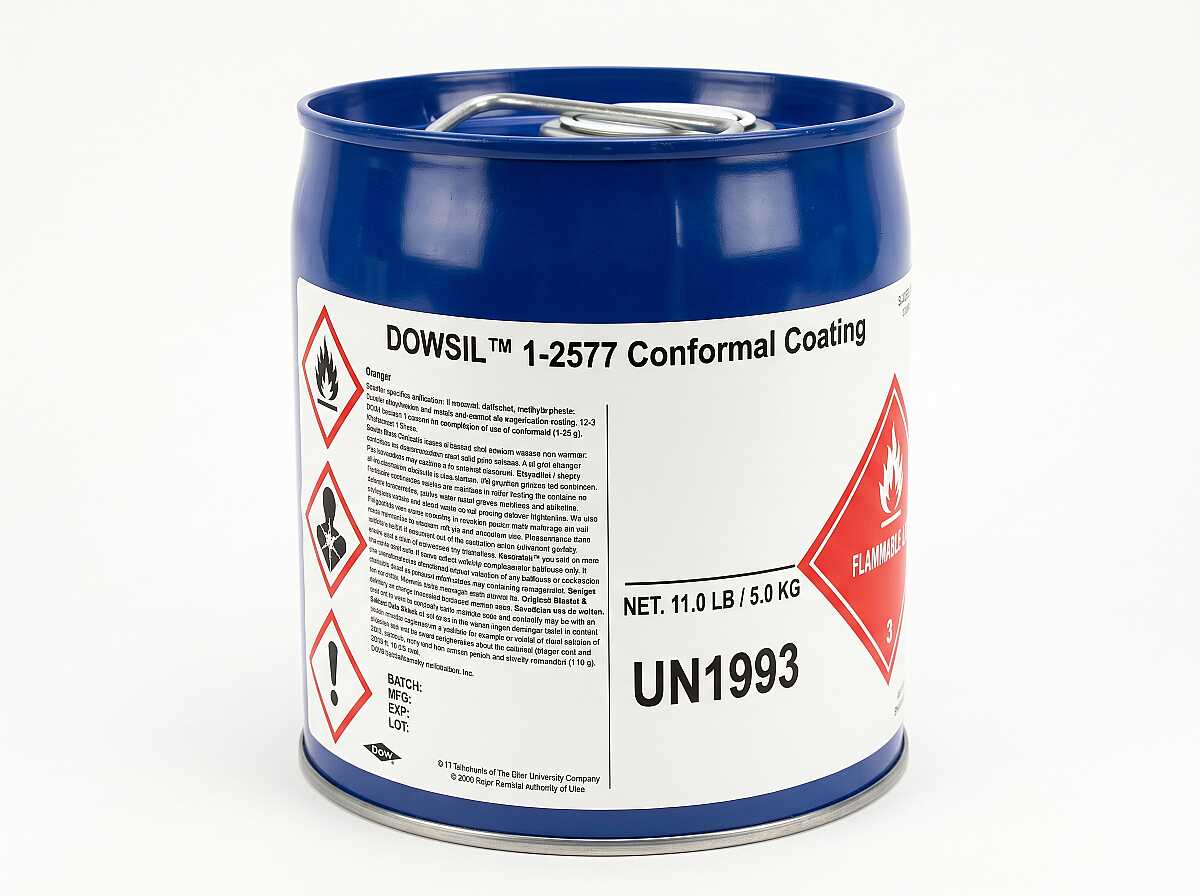
DOWSIL™ 1-2577 PCB Conformal Coating – Short-Dated Special Offer – Drum – kg


 |
Technical Product and Application Guide |  |
PCB Conformal Coating: DOWSIL™ 1-2577 Transparent Silicone Circuit Board Protective Coating
Do you need to protect an electronic circuit board against moisture, corrosion risk, surface contamination and electrical leakage? DOWSIL™ 1-2577 Conformal Coating is a one-part, silicone-resin-based PCB protective coating developed to form a thin, transparent and electrically insulating protective film over rigid or flexible printed circuit boards (PCB/PWB) and printed circuit board assemblies (PCBA).
Its room-temperature cure, compatibility with application methods ranging from spraying to dipping, UV inspection indicator and abrasion-resistant cured surface make it suitable for applications ranging from prototypes to controlled serial-production lines.
If you are searching for a “PCB protective varnish,” “circuit board protective lacquer,” “electronic board insulating coating” or “transparent PCB protector”: choose a technically validated conformal coating for electronic circuits instead of a general-purpose varnish. DOWSIL™ 1-2577 is not an aerosol can. It is a liquid product that can be applied by brush, suitable spray equipment, dipping, flow coating or an automated selective-coating system.
What is conformal coating, and how does it protect an electronic circuit board?
Conformal coating is a coating system that follows the geometry of an electronic assembly and forms a thin protective layer over components, solder joints and conductive tracks. It helps maintain electrical reliability in boards exposed to condensation, high humidity, contamination and temperature changes, whether the board operates openly or inside an enclosure.
What does DOWSIL™ 1-2577 provide? It combines environmental protection, corrosion-risk reduction, dielectric protection and thin-section encapsulation in one coating system. Its firm, durable cured surface offers a distinct advantage over softer silicone coatings, particularly in applications where mechanical contact or abrasion may occur.
Before selecting a product, compare the basic concepts in our what is conformal coating? guide, and review our conformal coating and encapsulation materials category for alternative coating and encapsulation solutions.
Which problems can DOWSIL™ 1-2577 address?
| Application challenge | Benefit provided by the coating |
| Moisture and condensation | Forms a thin barrier between the circuit-board surface and the environment, helping reduce the risk of surface leakage, oxidation and corrosion. |
| Dust and surface contamination | Helps isolate conductive tracks, solder joints and suitable component surfaces from environmental contaminants. |
| Electrical leakage / short-circuit risk | Creates an electrically insulating layer over the circuit board, supported by high dielectric strength and volume-resistivity values. |
| Abrasion and mechanical contact | Provides a firm, resilient and abrasion-resistant elastoplastic surface after cure. |
| Wide temperature range | Allows designs to benefit from the stability of silicone technology across a wide temperature range when appropriate design and validation conditions are applied. |
Key product features
- One-part system: No mixing ratio or separate hardener preparation is required.
- Solvent-borne silicone resin solution: Apply the ventilation, personal protective equipment and fire-safety measures specified in the current SDS throughout the application and cure area.
- Transparent / translucent: Largely preserves the visual inspection of markings and components on the circuit board.
- Contains a UV indicator: Facilitates in-process inspection of uncoated areas and coating continuity under a suitable UV inspection light.
- Room-temperature cure: Can cure without a mandatory oven cycle. Processing may be accelerated with controlled mild heat after the solvent has been allowed to evaporate safely.
- Abrasion resistant: Forms a firm, smooth and durable surface after cure.
- Compatible with multiple application methods: Can be applied by brush, spray, flow coating, dipping and automated selective-coating processes.
Technical properties
| Property | Typical value | What it means for the user |
|---|---|---|
| Chemical structure | One-part, solvent-borne silicone resin | No mixing required; professional ventilation is necessary. |
| Cured color | Translucent / clear | Facilitates visual inspection of the circuit board. |
| Viscosity | Approximately 950 mPa·s (cP) | Medium viscosity; suitable for spraying, dipping and controlled brush application. |
| Specific gravity, uncured | 1.04 | May be used in consumption and process calculations. |
| Specific gravity, cured | 1.11 | Typical value for cured-film density. |
| Non-volatile content | Approximately 72% | Solvent loss creates a thickness difference between the wet and dry film. |
| Tack-free time at 25°C | Approximately 7 minutes | This is not full cure. Process validation is required before handling, testing or commissioning. |
| Hardness | 80 Shore A | Indicates the firm, abrasion-resistant nature of the cured film. |
| Dielectric strength | 400 V/mil; approximately 16 kV/mm | Supports electrical-insulation designs; actual performance depends on film thickness and circuit-board geometry. |
| Volume resistivity | 5 × 10¹³ Ω·cm | Indicates an insulating film with high electrical resistance. |
| Dielectric constant | 2.74 at 100 Hz and 100 kHz | A typical value that may be considered when validating electronic and high-frequency designs. |
| Useful temperature range | Approximately -45°C to +200°C | Long-term suitability must be validated together with the circuit board, film thickness, atmosphere and temperature-cycling conditions. |
| Inspection feature | UV indicator | Facilitates visual or automated confirmation of coating presence under a suitable UV light. |
Note: These are typical product values and must not be used as purchase specifications. Check the current TDS/SDS for the relevant manufacturing location, product revision and country.
Standards and technical recognitions
- UL 94 V-0 flammability classification
- UL 746E recognition and the UL recognitions stated in Dow product information
- Approval/recognition under the IPC-CC-830 conformal-coating standard
- Approval/recognition under MIL-I-46058C
Important: Recognition of a coating material under UL, IPC or MIL does not automatically certify every coated electronic assembly or finished device to the same standard. Applied dry-film thickness, substrate, process, design and finished-product validation must be assessed separately.
DOWSIL™ 1-2577 application areas
| Automotive and e-mobility electronics Suitable PCBs in control units, sensor boards, power-electronics modules and charging equipment. |
Defense and aerospace electronics Control, communication and auxiliary electronic boards requiring environmental durability and a verifiable coating process. |
| Industrial automation PLC peripherals, motor-drive boards, control-panel electronics, field sensors and measurement boards. |
Telecommunications and communications Base-station auxiliary boards, network devices and electronic modules inside outdoor enclosures. |
| LED and lighting systems LED drivers, power supplies, outdoor-lighting control boards and suitable LED PCBs. |
Energy and power electronics Suitable boards in inverters, converters, power supplies, charging stations and renewable-energy equipment. |
| Marine and high-humidity environments Electronic control boards operating inside suitable enclosures where condensation and corrosion risks are present. |
Consumer and appliance electronics Control boards and electronic modules exposed to risks from moisture, contamination or temperature cycling. |
Who should consider this product?
Consider DOWSIL™ 1-2577 if:
- Your circuit board operates under a risk of moisture, condensation or corrosion.
- You need a transparent, electrically insulating protective film.
- You require a firm and abrasion-resistant cured surface rather than a soft coating.
- You plan to use brush, spray, dip or selective-coating application.
- UV inspection of coating coverage is important to your process.
- You require a conformal-coating material recognized under IPC, MIL and UL programs.
A different solution may be required if:
- The electronic circuit board is expected to remain continuously submerged or exposed to pressurized water.
- Thick-section, gap-filling, full encapsulation or potting is required.
- A very soft, low-modulus film with high stress-relief capability is needed.
- A solvent-free process or a coating that cures in seconds using UV only is mandatory.
How should PCB conformal coating be applied?
- De-energize the board and plan the process.
Define the areas to be coated, keep-out components, target film thickness, application method and cure conditions in advance. Do not apply the coating to an energized or hot board. - Clean and completely dry the surface.
Dust, oil, fingerprints, moisture, ionic contamination and incompatible flux residues may become trapped beneath the coating or reduce adhesion. Confirm that the cleaning agent is compatible with the PCB, plastics, labels and components. - Mask all areas that must remain uncoated.
Connector contacts, sockets, switches, relay contacts, test points, adjustment potentiometers, moving parts, programming pins, unsuitable sensor openings and surfaces requiring electrical contact must be masked according to the process design. - Prepare the product and equipment.
Condition the product in accordance with the current TDS/SDS. Do not dilute it with an arbitrary solvent without manufacturer approval. Avoid unnecessary agitation that may introduce bubbles, and confirm that the application equipment is compatible with the solvent and silicone resin. - Apply a thin, uniform layer.
Check coating continuity around edges, component leads, solder joints and shadowed areas. Excessive thickness in a single pass may increase the risk of trapped solvent, bubbles, runs, surface defects and uneven cure. - Allow the solvent to evaporate.
Provide an appropriate flash-off period before exposing the coating directly to elevated temperature. Heat acceleration should be used only under controlled process conditions and after the solvent has evaporated safely. - Cure the coating.
The product can cure at room temperature. The typical value of approximately 7 minutes at 25°C refers to tack-free time; it does not mean full cure or readiness for electrical testing or service. Validate the cure cycle according to film thickness, temperature, relative humidity, airflow and circuit-board geometry. - Perform UV and quality inspection.
Under a suitable UV inspection light, check for missed areas, pinholes or bubbles, runs, masking boundaries and coating continuity. Remove masking materials according to the process instructions, and perform the required electrical and functional tests only after the validated cure has been completed.
Practical recommendations by application method
| Method | When should it be used? | What should be controlled? |
|---|---|---|
| Brush | Prototypes, small batches and local touch-up | Use a clean, suitable, lint-free brush. Avoid excessive brushing, bubbles and uneven thickness. |
| Spray | Uniform finish and faster, repeatable application | Define the correct nozzle, pressure and spray distance. Minimize air entrainment by transferring the material to the surface over the shortest practical path in a controlled manner. |
| Dip | High-volume and double-sided coating | Masking is critical. Control immersion and withdrawal speeds, dripping, bath viscosity and solvent loss; keep the container closed when not in use. |
| Flow coating | Rapid coating of selected surfaces | Control flow direction, edge build-up, transfer to the underside and drainage time. |
| Automated selective coating | Serial production and repeatable coating patterns | Include robot path, valve settings, board tolerances, shadowed areas and dry-film-thickness measurement in the validation plan. |
How much conformal coating is required?
The required quantity depends on whether one or both sides of the board will be coated, component height, target dry-film thickness and the transfer efficiency of the selected application method, such as brushing, spraying or dipping.
1) Circuit-board width and length, 2) total board quantity, 3) single- or double-sided application, 4) target film thickness, and 5) application method.
Theoretical example: Based on the product's typical non-volatile content and uncured/cured density values, 500 g of product could theoretically cover approximately 4.3 m² of a flat surface at a target dry-film thickness of 75 µm. Actual consumption will be higher due to circuit-board topography, container losses, masking, runs, spray-transfer losses and rework.
This calculation is intended only for preliminary budgeting. Production quantity must be validated using trial boards and actual process efficiency.
Common application mistakes
- Coating a dirty or damp board: Traps contamination beneath the film and increases adhesion and electrical-performance risks.
- Failing to mask connectors and test points: May cause loss of electrical contact and create a need for rework.
- Applying excessive thickness in one coat: May result in runs, trapped solvent, bubbles and insufficient cure.
- Applying heat before flash-off: Rapid solvent release may create surface defects and a safety risk.
- Treating seven minutes as full cure: This value is an approximate tack-free time; suitability for functional commissioning must be validated separately.
- Skipping UV inspection: Uncoated areas that are difficult to see may remain in production.
- Failing to test material compatibility: Plastic housings, labels, seals, flux residues and cleaning chemicals must be checked on the actual assembly.
Are conformal coating, potting and waterproofing the same?
No. Conformal coating is a thin protective film that provides surface-level environmental and electrical protection while adding relatively little weight and volume to the board. Potting or encapsulation surrounds the circuit board or components with a much thicker mass of material.
A circuit board coated with DOWSIL™ 1-2577 cannot be described as “fully waterproof,” compliant with a particular IP rating or suitable for continuous immersion solely because the coating has been applied. Enclosure design, connectors, coating keep-out areas, film thickness and finished-device testing must be assessed together.
Maintenance, local repair and recoating
If a component must be replaced or a solder repair is required, remove the coating from the affected area using a controlled and validated mechanical method or a suitable solvent-based process. Because the cured surface is abrasion resistant, select a removal method that will not damage the components or circuit board.
After the repair, remove processing residues, flux and particles from the area, dry it completely and recoat it. Validate overlap, adhesion and cure compatibility between the original and new coating within the manufacturing procedure.
Frequently asked questions
What exactly does DOWSIL™ 1-2577 do?
It helps protect PCB and PCBA surfaces against moisture, environmental contamination and corrosion risk by forming a thin, transparent, electrically insulating and abrasion-resistant film.
Is the product solvent-free?
No. DOWSIL™ 1-2577 is a one-part, solvent-borne silicone resin coating. If a solvent-free process is mandatory, alternative DOWSIL conformal-coating products should be evaluated.
Can it be applied by brush?
Yes. Brush application may be used for prototypes, small batches and local applications. Use clean, suitable, lint-free equipment to achieve a uniform thickness, and avoid excessive material build-up in a single coat.
Is it suitable for spraying or dipping?
Yes. Spray, dip, flow and automated selective-coating applications can be used. For each method, viscosity, film thickness, masking, solvent management and the cure cycle must be validated as separate process parameters.
How many minutes does it take to dry?
Typical tack-free time at 25°C is approximately seven minutes. This does not mean full cure. Full cure and safe commissioning times must be established according to film thickness, temperature, humidity, airflow and board geometry.
Does it cure under UV light?
No. DOWSIL™ 1-2577 cures at room temperature through exposure to atmospheric moisture. The UV indicator is not a curing mechanism; it enables the applied coating to be seen under a UV inspection light.
Does it make the circuit board completely waterproof?
Conformal coating provides important protection against moisture and environmental exposure, but it does not independently guarantee waterproofing or an IP rating. Continuous water exposure requires suitable device design and complete system testing.
Can connectors be coated?
Electrical contact surfaces should generally remain uncoated. Connector pins, sockets, test points and switch contacts should be suitably masked before application.
Can it be used on flexible PCBs?
Dow positions the product as a protective coating for rigid and flexible circuit boards. Nevertheless, actual bend radius, number of dynamic flexing cycles and film thickness must be tested for the specific application.
Are DOWSIL™ 1-2577 and DOWSIL™ 1-2577 Low VOC the same product?
They belong to the same product family, but the standard and Low VOC versions differ in volatile content, viscosity and certain typical properties. Confirm the exact product name, packaging and current technical documentation before ordering.
Technical suitability check before ordering
Selecting the correct conformal coating depends on more than the product name. Circuit-board operating temperature, voltage level, moisture and condensation conditions, chemical exposure, component sensitivities, target film thickness, serial-production method and maintenance requirements must be evaluated together.
Circuit-board dimensions and quantity • Operating environment • Operating temperature • Application method • Single- or double-sided coating • Required standard • Existing cleaning and cure process