EN − TL
 Türkçe

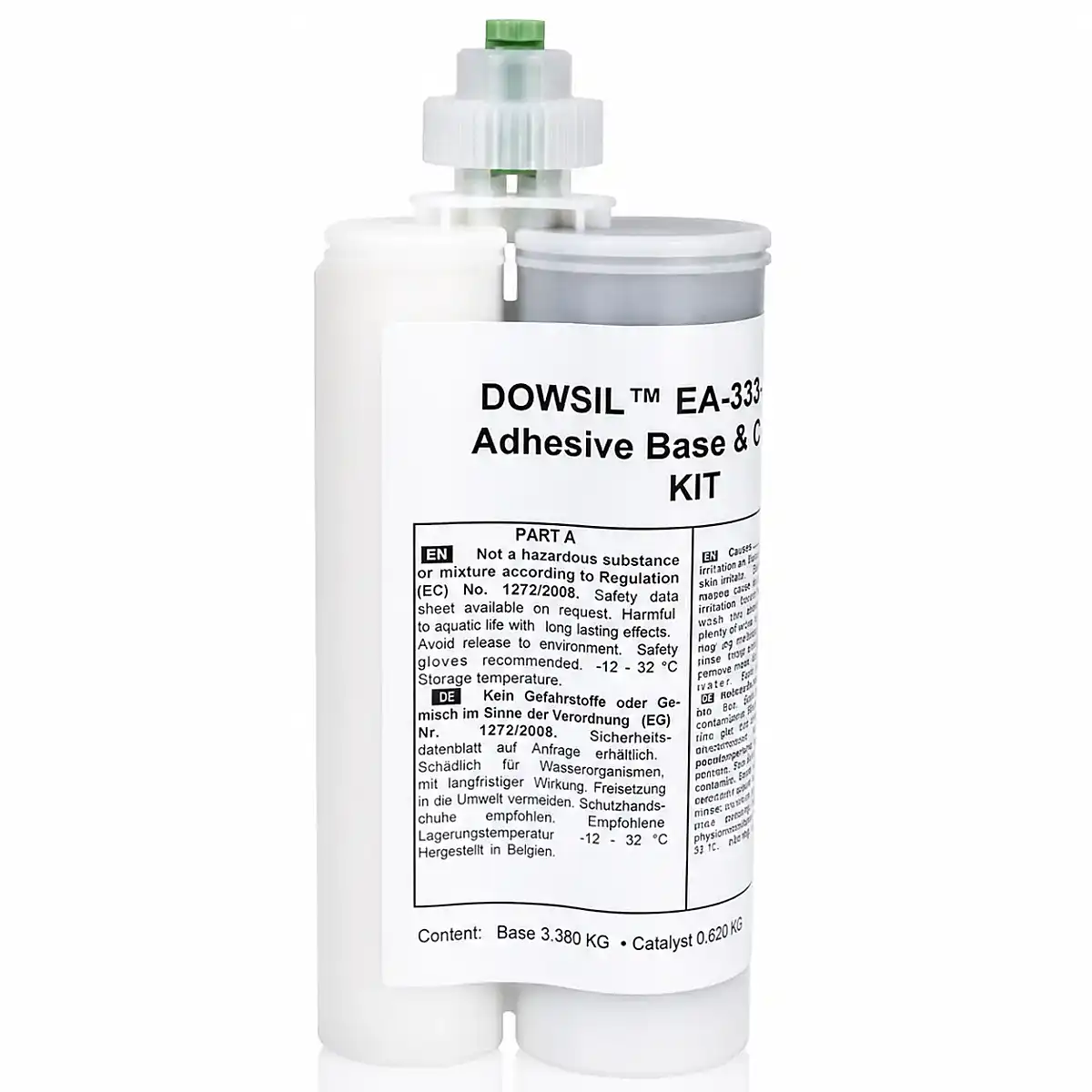
DOWSIL™ EA-2626 Two-Part Fast-Curing Silicone Adhesive
DOWSIL EA-2626 is a two-part, fast-curing silicone adhesive and sealant for durable bonding of glass, metal and plastics. Contact TeknikExpo for pricing, availability and technical documentation.
 |
Technical Product and Application Guide |  |
DOWSIL™ EA-2626 Two-Part Fast-Curing Silicone Adhesive
Do you need fast, durable and flexible bonding between glass, metal and plastic components? DOWSIL™ EA-2626 Adhesive is a two-part, fast room-temperature-curing, non-self-leveling paste adhesive and sealant system comprising DOWSIL™ EA-2626 Base and either SILASTIC™ Q3-3636 Grey or Special Black Catalyst.
It is designed for bonding components with different thermal expansion rates. Typical applications include automotive headlamps and fog lamps, ovens and ceramic hobs where rapid handling strength, weather resistance and high-temperature performance are required.
What is DOWSIL™ EA-2626?
DOWSIL™ EA-2626 is a two-part silicone adhesive and sealant developed for applications where fast cure requirements make one-part room-temperature-vulcanizing (RTV) adhesives unsuitable. Unlike conventional one-part moisture-cure systems that cure from the outside inward, it delivers rapid cure in depth.
After cure, it provides durable adhesion to glass, plastics and metals, together with resistance to weathering, UV exposure and temperatures up to 190°C. Its paste consistency and typical flow of less than 2 mm support controlled application on inclined or vertical surfaces.
Primary applications
| Application area | Typical use | Benefit |
|---|---|---|
| Automotive lighting | Bonding polycarbonate or glass lenses to reflector housings in headlamps and fog lamps | Accommodates different thermal expansion rates while providing fast cure and durable sealing |
| Ovens and ceramic hobs | Glass-to-metal, glass-to-painted-metal and glass-to-plastic assembly | Resistance to elevated temperatures, weathering and hot-humid conditions |
| Industrial assembly | Bonding and sealing plastic, metal and glass components | Non-sag consistency, rapid handling and broad substrate compatibility |
| Dissimilar materials | Joining materials that expand at different rates during thermal cycling | The silicone elastomer helps accommodate movement and stress |
Key features and benefits
- Two-part adhesive/sealant: DOWSIL™ EA-2626 Base is used with SILASTIC™ Q3-3636 Grey or Special Black Catalyst.
- Fast cure: Short working and tack-free times at room temperature allow bonded components to be handled rapidly.
- Neutral alkoxy cure: Designed for industrial bonding and sealing applications.
- Non-self-leveling paste consistency: Supports controlled dispensing on vertical, inclined and complex surfaces.
- Durable adhesion: Develops strong adhesion to substrates including glass, plastics and metals.
- Environmental resistance: Resists weathering, UV exposure and temperatures up to 190°C.
- Rapid in-depth cure: Does not rely on the outside-in cure mechanism typical of one-part moisture-cure adhesives.
Components and mix ratio
The system combines white-paste DOWSIL™ EA-2626 Base with either grey or special-black SILASTIC™ Q3-3636 Catalyst.
| Mixing basis | Ratio | Explanation |
|---|---|---|
| By weight | 100 parts base : 13 parts catalyst | The standard mix ratio stated in the TDS. |
| By volume | 5.7-5.9 parts base : 1 part catalyst | The stated volume range for the Grey and Special Black catalyst options. |
Consult Dow before using other mix ratios. For production, suitable meter/mix equipment should use gear or piston metering pumps for the base and catalyst, with an appropriate static or dynamic mixer.
Typical uncured properties
| Component / property | Grey Catalyst system | Special Black Catalyst system |
|---|---|---|
| DOWSIL™ EA-2626 Base appearance | White paste | White paste |
| Base viscosity | 205,000 mPa·s | 205,000 mPa·s |
| Base specific gravity | 1.36 | 1.36 |
| Catalyst viscosity | 18,000-48,000 mPa·s | Approximately 350,000 mPa·s* |
| Catalyst specific gravity | 1.00 | 1.04 |
| Working time, snap | 6-9 minutes | 6-9 minutes |
| Tack-free time | 11-18 minutes | 11-18 minutes |
| Flow | < 2 mm | < 2 mm |
| Mixed specific gravity | 1.32 | 1.33 |
| Mixed color / RAL | Grey / RAL 7000 | Special Black / RAL 7021 |
* The TDS also reports a penetration-test consistency value of 180-460 mm/10 for Special Black Catalyst. Values are typical and are not intended for preparing specifications.
Typical mechanical properties after full cure
| Property | Grey Catalyst | Special Black Catalyst | Test condition |
|---|---|---|---|
| Hardness | 43 Shore A | 45 Shore A | 7 days at 23°C; 2 mm sheets |
| Tensile strength | > 1.9 MPa | > 1.9 MPa | 7 days at 23°C |
| Elongation at break | > 200% | > 200% | 7 days at 23°C |
| Peel test on clear polycarbonate | 100% cohesive failure | 100% cohesive failure | 24 hours at 23°C |
| PC/glass lap-shear strength | > 1.0 MPa | > 1.0 MPa | 24 hours at 23°C |
| PBT-ASA/glass lap-shear strength | > 1.0 MPa | > 1.0 MPa | 24 hours at 23°C |
| PC/PP lap-shear strength | > 1.0 MPa | > 1.0 MPa | Plasma-treated PP; 24 hours at 23°C |
Results are typical values obtained using Dow Corporate Test Methods. Validate performance under the actual component and process conditions.
Surface preparation and adhesion
- Clean the surfaces: Bonding areas must be free from oil, dust, dirt, moisture and other foreign matter.
- Test the actual substrates: Paints, plastic additives, mold-release agents and surface finishes may affect adhesion.
- Primer is not normally required: According to the TDS, good adhesion can be achieved on many substrates without a primer or surface activation.
- Activate when necessary: Flame or plasma treatment can improve adhesion and is particularly important for low-energy surfaces such as polypropylene.
Application and curing steps
- Condition the base and catalyst. Prepare both materials at a temperature suitable for the current TDS/SDS and validated process.
- Meter at the correct ratio. The standard ratio is 100:13 by weight. Use suitable meter/mix equipment for consistent proportioning.
- Mix uniformly. Use a static or dynamic mixer until color and consistency are fully uniform.
- Apply within the working time. Typical working time is 6-9 minutes; plan equipment and assembly accordingly.
- Join and fixture the components. Ensure adequate wetting of the bonding surfaces and apply the required fixturing.
- Cure at room temperature. Typical tack-free time is 11-18 minutes; this does not indicate full cure.
- Use controlled heat if required. Cure and adhesion development may be accelerated, for example, by applying moderate heat for about 10 minutes at 60-70°C. Validate the process on the actual components.
Hot and humid resistance
DOWSIL™ EA-2626 shows good adhesive resistance under hot and humid conditions. The TDS cites seven days in water at 70°C as an example. This does not automatically qualify the finished component for continuous immersion or a specific IP rating; finished-product testing is required.
Storage and usable life
| Component | Storage condition | Usable life in original unopened container |
|---|---|---|
| DOWSIL™ EA-2626 Base | At or below 32°C | 12 months from the date of production |
| SILASTIC™ Q3-3636 Grey / Special Black Catalyst | At or below 25°C | 5 months from the date of production |
Store in the original unopened container. Follow the batch-specific use-by date on the package and the current SDS/TDS.
Frequently asked questions
Is DOWSIL™ EA-2626 a one-part adhesive?
No. It is a two-part system that combines DOWSIL™ EA-2626 Base with SILASTIC™ Q3-3636 Grey or Special Black Catalyst.
What is the mix ratio?
The standard ratio is 100 parts base to 13 parts catalyst by weight. By volume, it is approximately 5.7-5.9 parts base to 1 part catalyst, depending on the catalyst option.
How quickly does it cure?
Typical working time is 6-9 minutes and tack-free time is 11-18 minutes. The TDS reports full-cure properties after seven days at 23°C. Validate the time required before handling or service in the actual process.
Can it be used on vertical surfaces?
Its non-self-leveling paste consistency and typical flow of less than 2 mm support controlled use on vertical and inclined surfaces.
Which substrates can it bond?
It is designed to develop durable adhesion to glass, metals and a range of plastics. Low-energy plastics such as polypropylene may require flame or plasma treatment.
What is its heat resistance?
The TDS states resistance to weathering, UV exposure and heat up to 190°C. Continuous service temperature and actual performance must be tested with the substrate, joint geometry, load and thermal-cycle conditions.